Granny Square Birds in Different Yarn Weights

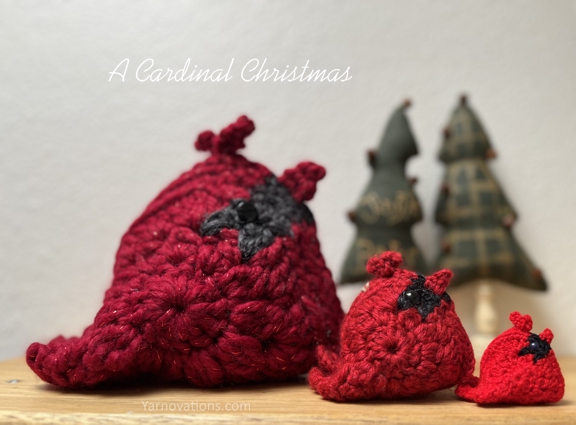
3 Cardinals crocheted in different size yarns from the crochet pattern "Birds of a Feather"

Can you use larger or smaller yarn to crochet the Granny Square “Birds of a Feather”?

Great question! We’ve been asked if the granny square “Birds of a Feather” crochet pattern can made with larger (chenille yarn) or smaller (cotton thread) yarn. The simple answer is, Yes!

No changes are needed for the crochet portion of the pattern if you want to make a bird in larger or smaller yarn. As expected, the thicker or bulkier the yarn, the larger the bird and conversely, the thinner the yarn, the smaller the bird. The only change you’ll need to make in the pattern is the size of the eyes and crochet hook.

Pictured above are 3 cardinals made with different size yarn with NO changes to the crocheted portion of the pattern.

  • Left: Lion Brand Wool-Ease Thick & Quick, super bulky, 79% acrylic, 20% wool, 1% other
  • Middle: Lion Brand Heartland, medium worsted weight acrylic
  • Right: Aunt Lydia’s Cotton Thread #5
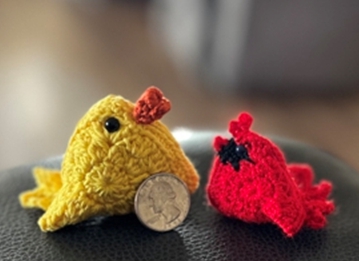
  • Rubber Duckie: (pictured below): Paton Grace #3 light weight yarn, mercerized cotton
Observations about Working with Different Size Yarn

  1. For most yarns we used a hook 1 or 2 sizes smaller than the yarn label recommended.
  2. Thicker yarn will made a bird that may feel more squishy and appear more holey. It’s great for cuddling.
  3. Thinner yarn makes it more difficult to see your stitches. Cotton thread creates a stiffer bird. Great for creating little charms for bags or Christmas ornaments.

Pattern Modifications for Change in Yarn Size

EYES

You’ll want to increase or decrease the size of the button or safety eye depending on the size bird you crochet. Here’s what we used in those pictured on this post.

  • Large cardinal used 5/8” buttons (loop back button which looks similar to a safety eye).
  • Medium cardinal used 10 mm safety eyes.
  • Small cardinal used 5 mm mini brads (like those used in scrapbooking).
  • Rubber Duckie used 6 mm safety eyes.

Birds, Birds, More Birds

There are so many beautiful birds in the world…and we’ve recreated several of them in 2 different crochet patterns. Each bird in these sets are made from 2 granny squares with color changes at just the right place to create different birds. Here’s what’s in each volume:
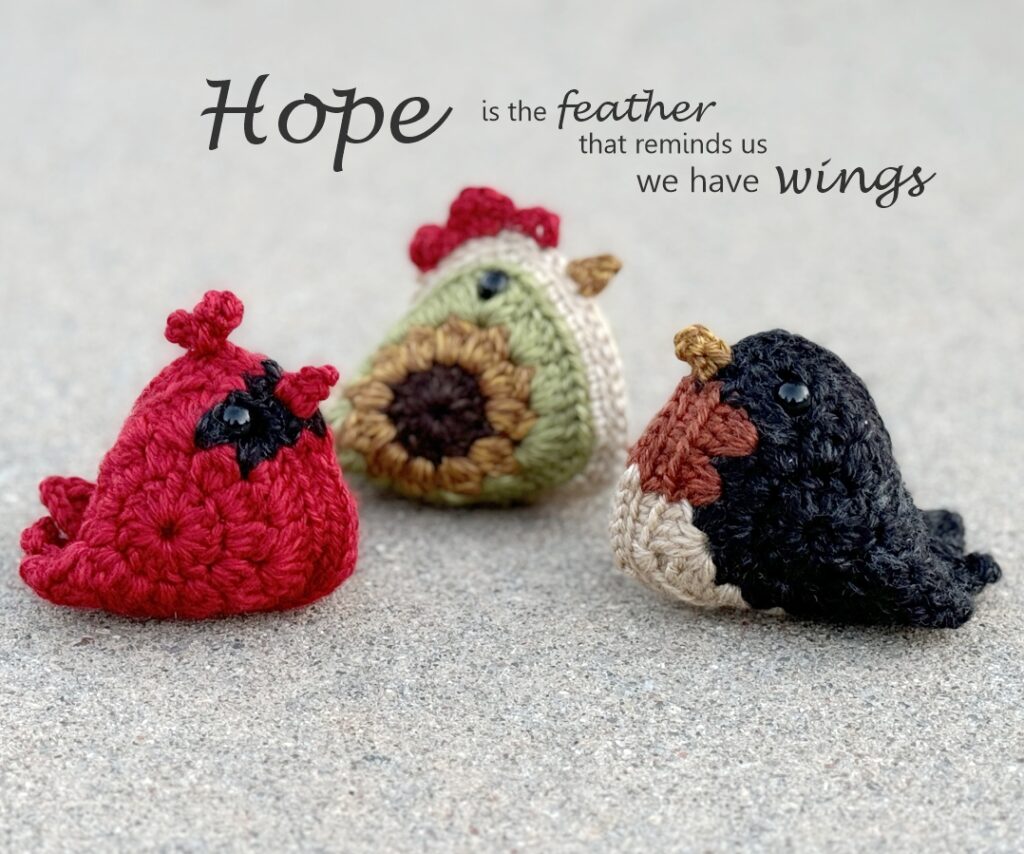
Birds of a Feather, Volume 1

The original set has 9 gorgeous birds that are fun to decorate with and for gifting. Birds of a Feather, Volume 1 is available on Etsy and includes the following birds:

  • Sunflower Chicken
  • Bald Eagle
  • Bluejay
  • Cardinal
  • Goldfinch
  • House Finch
  • Parakeet
  • Robin
  • Turkey
  • + Bonus: Mini Pumpkin
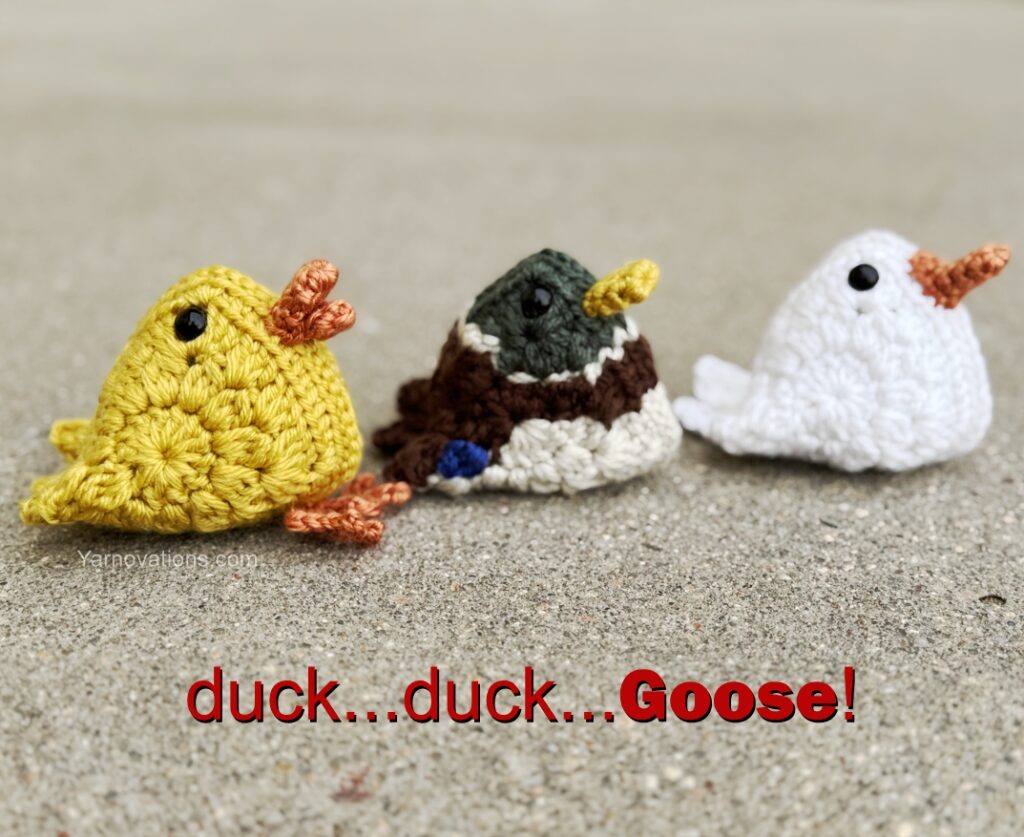
Duck, duck, goose. 3 birds each made from 2 granny squares. Left is rubber duckie, middle is a mallard, right is a goose.

Birds of a Feather, Volume 2

2 new features were added to Birds of a Feather, Volume 2. The step-by-step instructions for turning granny square birds (any from vol. 1 and 2) into a cell phone holder or a zippered pouch! Volume 2 also introduces some fun techniques to create birds with texture like furry feathers and 3D feathers! This set includes several exciting new birds including:

  • Blackbird / Crow / Raven / Dove
  • Black Breasted Red Phoenix Rooster
  • European Robin
  • Flamingo (2 styles)
  • Goose / Mother Goose
  • Mallard
  • Red Winged Blackbird
  • Rubber Duckie
  • Seagull
  • Stork with Baby Bundle

The crochet pattern for these fine feathered friends are available now on Etsy:
Scrubby Yarn Tips & Tricks for Pin Loom Weaving

Tips and tricks are definitely needed if you plan to weave with scrubby yarn. It makes the BEST dishcloths for handwashing dishes but the yarn is definitely aggravating to work with. We’ve made lots of variations of an 8″ dishcloth and learned a thing or two…and maybe said a colorful word or two, as well.

How to weave scrubby yarn without pulling all your hair out!!

Scrubby yarn makes wonderful woven dishcloths that are pliable and durable. Made from polyester, this yarn has lots of little tendrils sticking out which give it an abrasive quality, without actually being abrasive. The rough texture makes it great for washing dishes, but a challenge for weaving on a pin loom using multiple warp layers, like the looms with a 3-pin configuration. Not only do all the little tendrils make it difficult to see each warp strand around which to weave, the needle invariably snags a tendril making it nearly impossible to pull the needle through each layer.

After weaving quite a few Scrubby squares, we found a few tricks to make weaving with this yarn a little less frustrating (though not completely fool-proof)!

Pin Loom Weaving with Scrubby Yarn Tip 1:

Push nearby warp strands out of the way as you weave to isolate the strand around which you are weaving. This helps you find the warp strands you want, as the tendrils often make it difficult to see the different strands. By pushing neighboring warp strands out of the way, you are also less likely to snag a stray tendril.

Pin Loom Weaving with Scrubby Yarn Tip 2:

Exaggerate the up and down of the needle. Make the needle go very high when weaving over, and very low when weaving under to try to go over the tendrils.

Pin Loom Weaving with Scrubby Yarn Tip 3:

Pull out a weft row. Unfortunately, you won’t know that you have snagged a tendril or split a warp strand until you start to pull the needle through. And you won’t know where the problem is until the eye of the needle gets to the problem. With extreme care, you can attempt to pull the weft from the needle and pull the row out from the side, but this will be a tiresome task.

Pin Loom Weaving with Scrubby Yarn Tip 4:

Hulk out! More than one square was made with me losing my cool. After much careful but (quite) forceful tugging, I’ve managed to force the needle to pass through the row. More often than not, this has ended up in some tendril pulling and breaking. Surprisingly, the square holds up. It doesn’t unravel and can still be used.

Pin Loom Weaving with Scrubby Yarn Tip 5:

Use the continuous strand weaving method. This method uses a hook, and creates the warp and weft as you go. No more piercing or splitting a strand or tendril with a needle, unless the pin loom shape you are weaving also has a plain weave section, like a hexagon.

Pin Loom Weaving with Scrubby Yarn Tip 6:

Weave with cotton and scrubby yarn in different layers. This is probably the best way to weave scrubby, or at least the least frustrating way!

Hip to Be Square Pin Loom Pattern

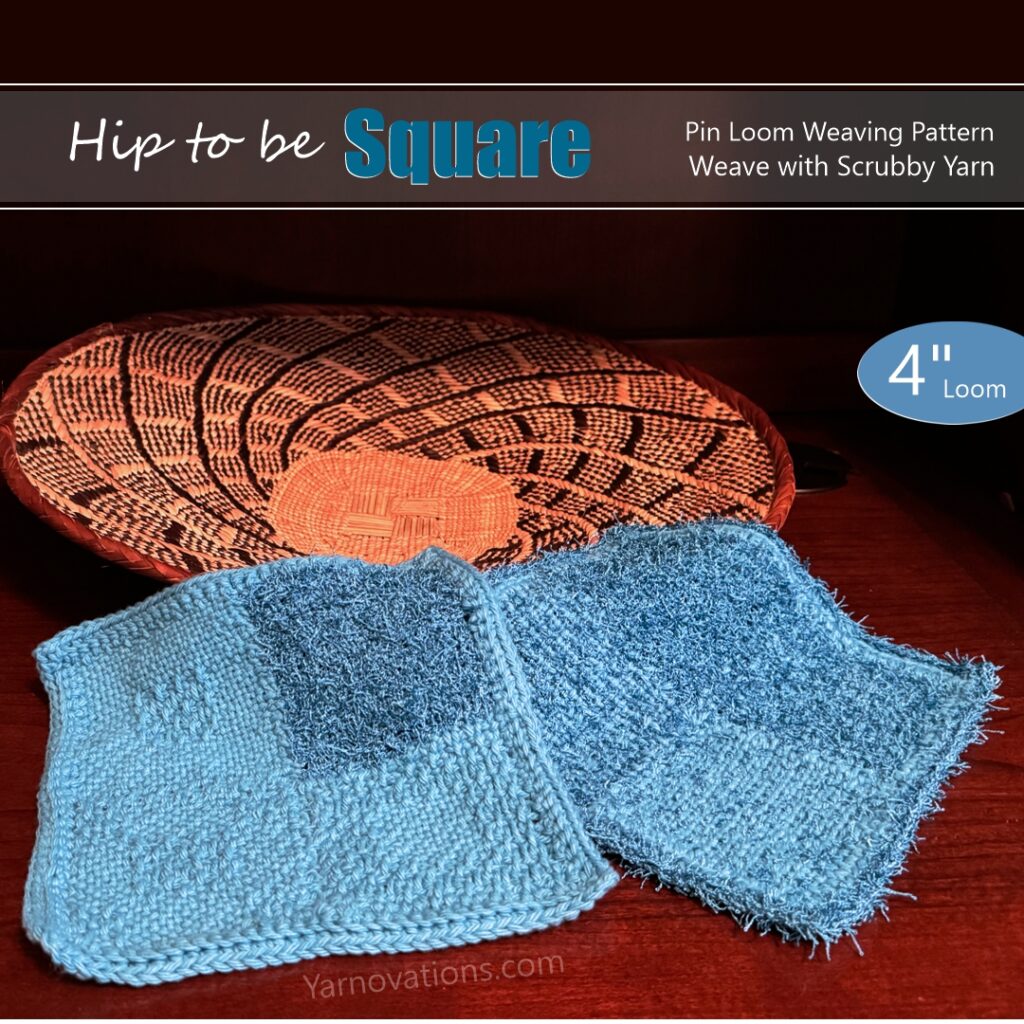
We love gifting dishcloths woven in cotton and scrubby yarn and created a super fun design using a 4″ square pin loom. We call it, “Hip to be Square” because there are 3 embossed square weaving designs along with a scrubby square. This 4″ pin loom square pattern includes all the tips listed here and more!

Hip to be Square pattern includes:

  • Hip to Be Square Dishcloth Pattern
  • 3 Embossed Squares Weaving Patterns
  • 6 Variations on cotton / scrubby dishcloths
  • 6 Weaving Tips
  • 3 Finishing Tips
  • Comparison of crochet vs weaving with scrubby

Hip to Be Square on Etsy

The Hip to Be Square Dishcloth Pin Loom Pattern is available in our Etsy shop. It includes all the tips, tricks and weaving variations.

Available now on Etsy.

More about Hip to Be Square Pin Loom Dischloth

One of the great features of pin loom weaving dishcloths is that the supplies needed are minimal and with only 2 balls of you yarn, you can made several dishcloths! And even better than that…you only need one pin loom, a 4″ square. Here’s what you’ll need to make this giftable dishie:

  • Yarn:         Lily: Sugar’n Cream – 100% cotton, Medium (4) – 1 skein
  • Red Heart: Scrubby – 100% polyester, Medium (4) – 1 skein
  • Pin Loom: 4” square
  • Needle:     6” weaving needle, yarn needle for sewing
  • Crochet Hook: G/6/4.00mm (optional)

This dishcloth first appeared in Little Looms magazine. We have the rights back to this project and have created a pattern packed full of more tips and tricks. Get your Hip to Be Square Pin Loom Pattern on Etsy.

Selecting Yarn for Pin Loom Weaving

Unlike knit and crochet, you can’t change the pin size on the pin loom to weave with yarns of various weights. The pins are fixed and to get a traditional weave, you are limited to a certain size of yarn. Or are you? Let’s take a closer look at yarns and what yarns work best for pin loom weaving.

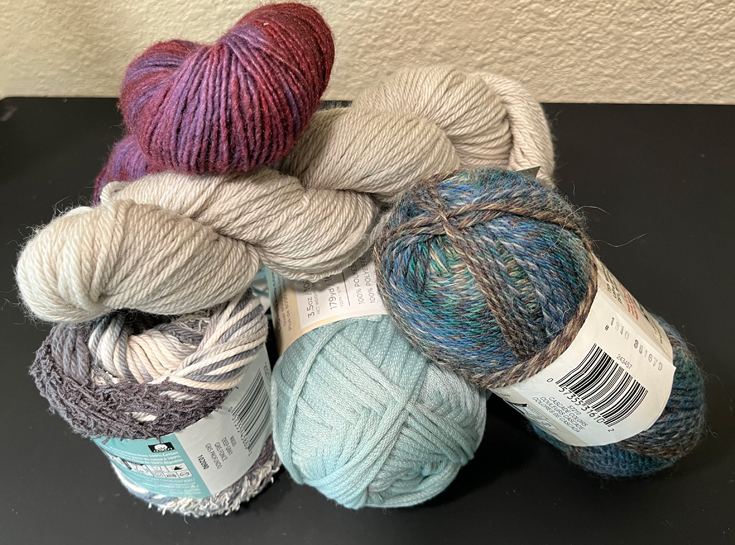
Three variables should be considered when selecting yarn for pin loom weaving: yarn weight, fiber content and yarn structure. Below is a photo of yarns in various fibers and weights including wool, silk, nylon, cotton and polyester in superfine (1), sport (3), and medium worsted (4) weight.

See Yarn Label for Details

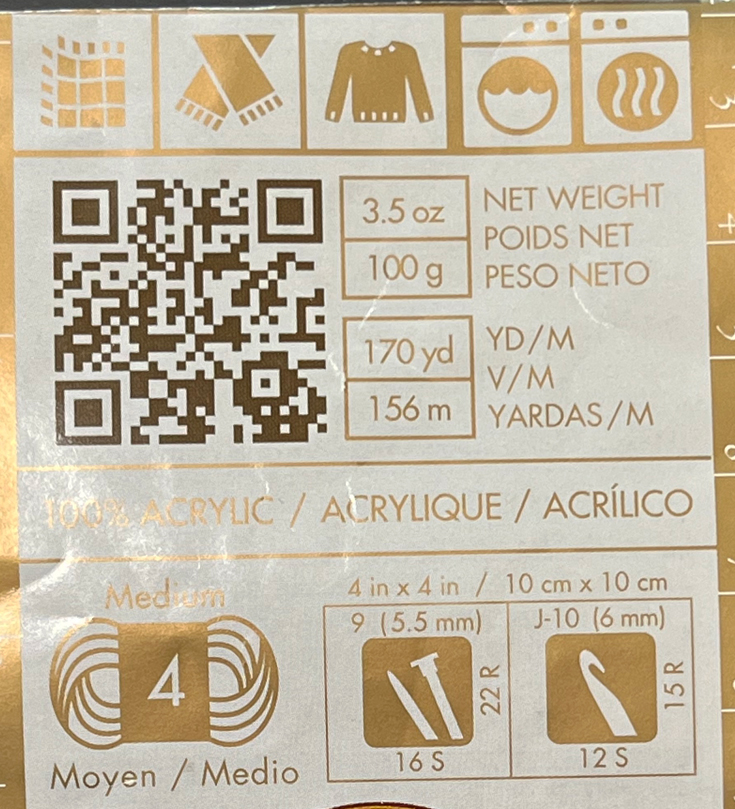
Yarn labels have a wealth of information. Some have more info while others make you turn to the internet for answers. Refer to the label below and see if you can find the following information:

  • Washing instructions (yes, you can wash and dry this – elsewhere on the label it gave more detail washing information)
  • yarn fiber (100% acrylic)
  • yarn weight (medium worsted (4))
  • skein weight (3.5 oz/100 g)
  • skein length (170 yd/156m)
  • knitting needles recommended (9/5.5mm)
  • crochet hooks recommended (J/10/6mm)
  • this label even says it’s great for making afghans, scarves and sweaters!

Yarn Weight for Pin Loom Weaving

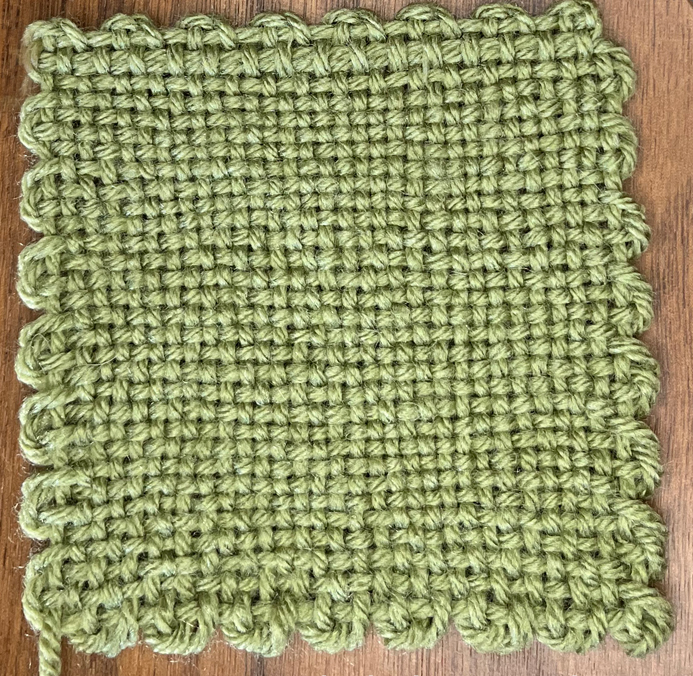
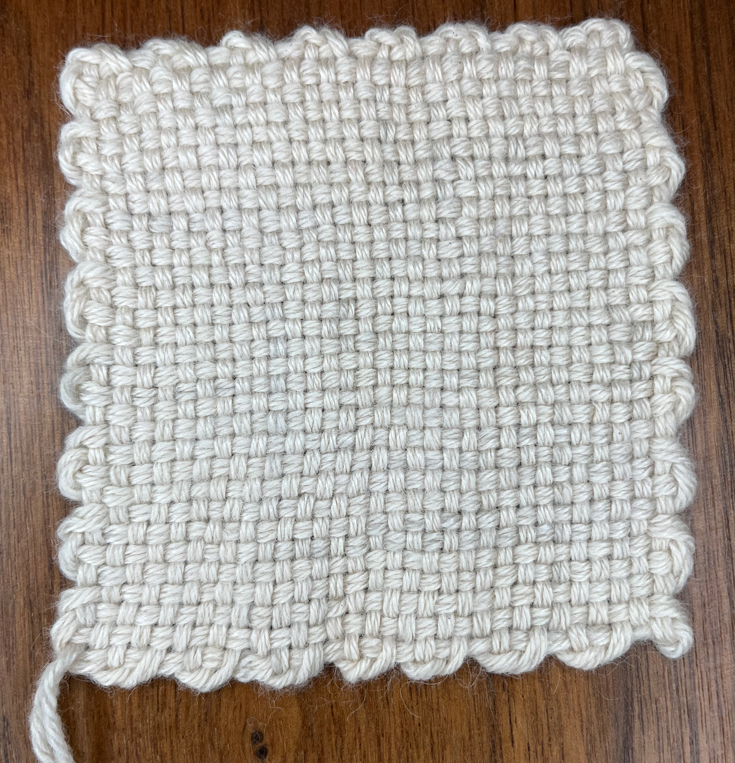
A thin yarn creates a fabric with large holes between strands while a thick yarn creates a fabric that’s really dense. Most people weave with yarn that’s somewhere in the middle. Below is a photo of a 4″ square woven in Lion Brand Yarns Vanna’s Choice which is a medium worsted weight (4) yarn.

Light or DK weight (3) and medium worsted weight (4) are what most people use to weave on a standard pin loom. It creates a fabric that has some drape but also tight enough to use for flat or shaped projects like afghans, shawls and toys.

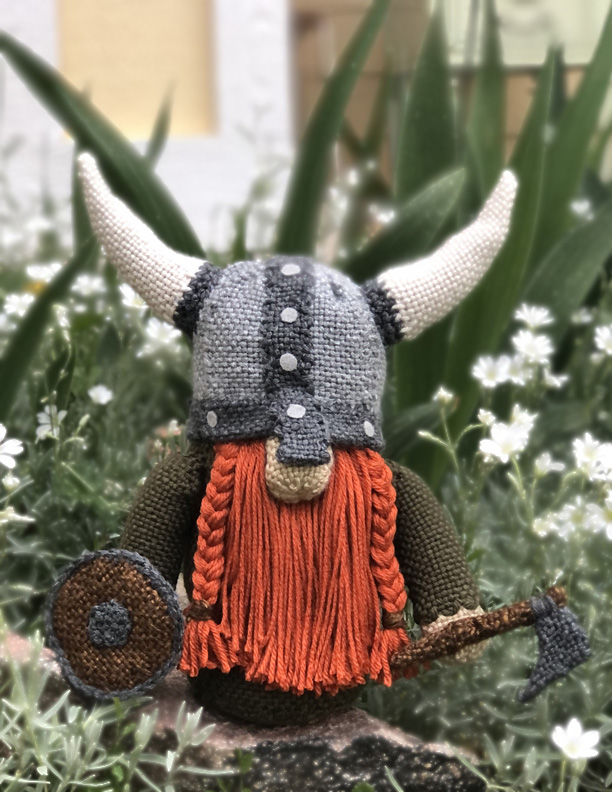
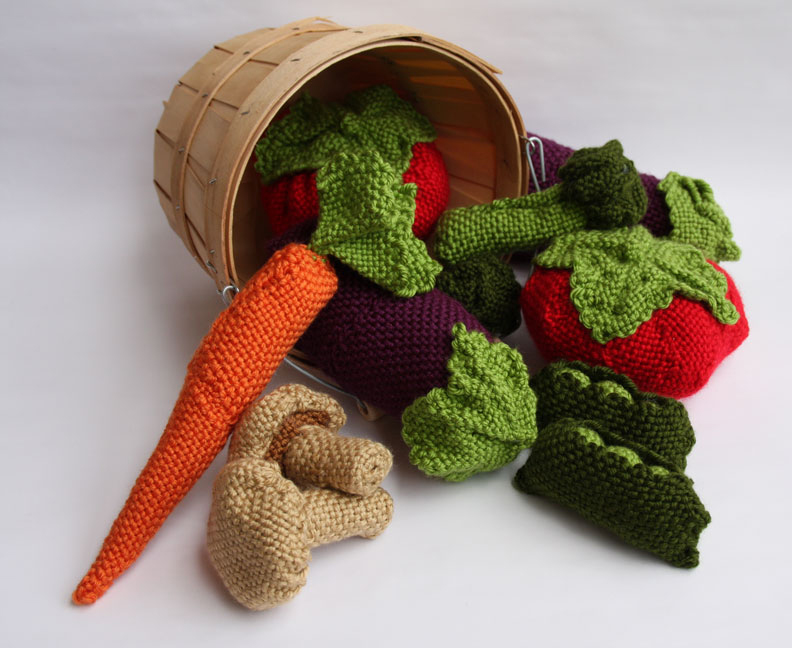
We’ve made afghans, gnomes and even vegetables with worsted weight yarn! Pictured below, the Viking Gnome was made primarily with Lion Brand Basic Stitch (4). The vegetables were made with Red Heart Soft (4).

Fine (2), superfine (1) and lace (0) weight yarn can also be used. For very loosely woven fabric, weave it as a single strand. For a drape similar to light or worsted weight yarn, then double up the threads.

Below is a photo of a 4″ square made with superfine (1) yarn held double for both warping (wrapping yarn on) the loom and weaving the square.

two strands of superfine yarn on pin loom

Yarns labeled bulky (5), super bulky (6) and jumbo (7) are too big for most pin looms. There are some pin looms with more space between the pins, but those are not as common. So as a general rule you want to avoid these fibers. But…maybe not. See Breaking the Rules below.

Yarn Fiber Content for Pin Loom Weaving

The great news is you can weave with any type of yarn whether it’s animal or plant based, man made or repurposed material. The bad news is, some materials are easier to weave than others.

The easiest yarn to pin loom weave with those with elasticity. When you pull on the strand, does the yarn stretch? If so, than it has some elasticity and will be easier to weave. Examples would be acrylic and wool.

warping pin loom with acrylic vs cotton

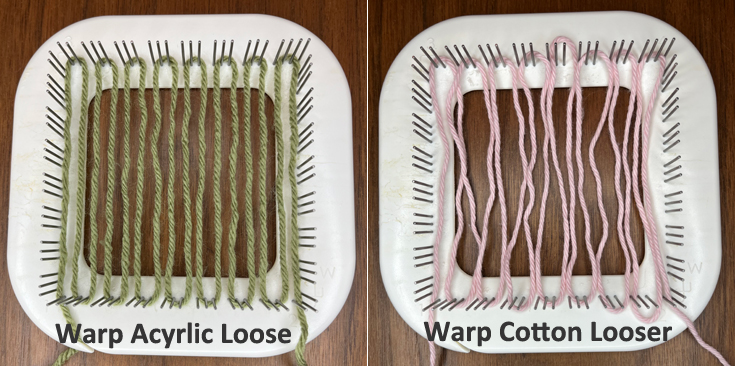
The yarns more challenging to weave are made with fibers/materials that have no elasticity like cotton and bamboo. They can also be used for pin loom projects and may even be preferred because of their fiber content (like dishcloths). You will just need to weave a little differently. Namely, you need to warp (wrap the loom) more loosely, see photo above for reference).

Yarn Structure for Pin Loom Weaving

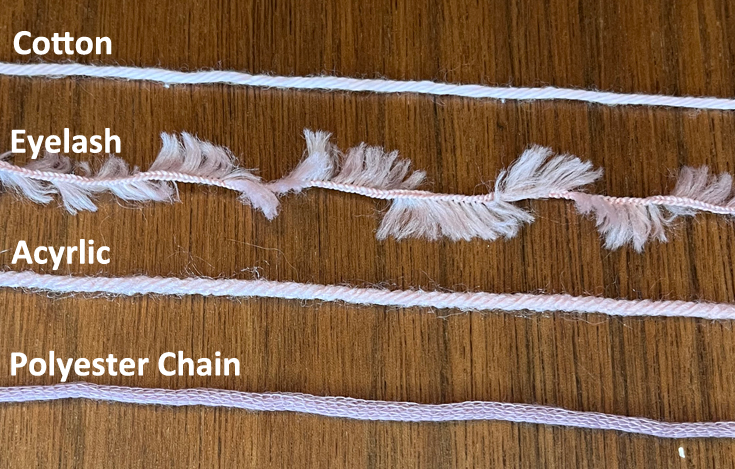
Basically you’re looking for smooth vs. textured yarns. A smooth spun yarn like the cotton, acrylic and polyester chain pictured below are easier to weave because you will be able to see your strands as you weave. The Eyelash yarn will make it difficult to see your strands.

Most yarns are not single stranded, meaning they are constructed with 2 or more strands/plys twisted together. There is an S twist, Z twist, chain and more. Above, the cotton and acrylic are S twist and the polyester is a chain. We haven’t noticed any difference in S vs. Z twist and are mostly concerned about yarns that have bumps, halos (fuzzy) and eyelashes. Textured yarns are super challenging to weave on a pin loom and generally avoided. But…see Breaking the Rules, below.

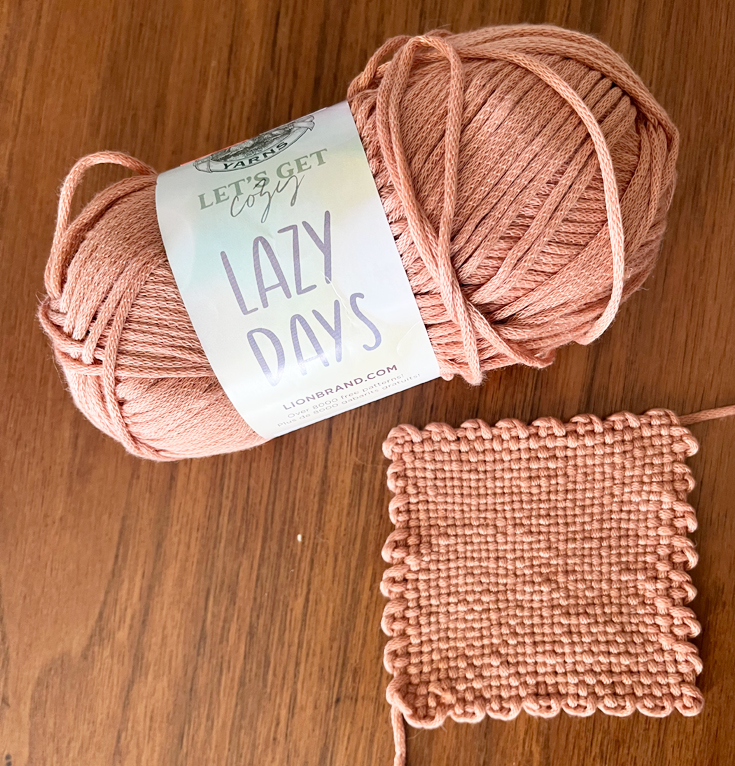
The polyester chain (Lion Brand Let’s Get Cozy Lazy Days) has a nice elasticity and weaves up nicely, though it’s easy to accidently split the yarn. Just be sure not to pull too tightly as you finish pulling the yarn each weave. You don’t want to “cinch” it which will cause the square to have concave looking sides. As mentioned, the smooth texture of the chain makes it really nice to weave.

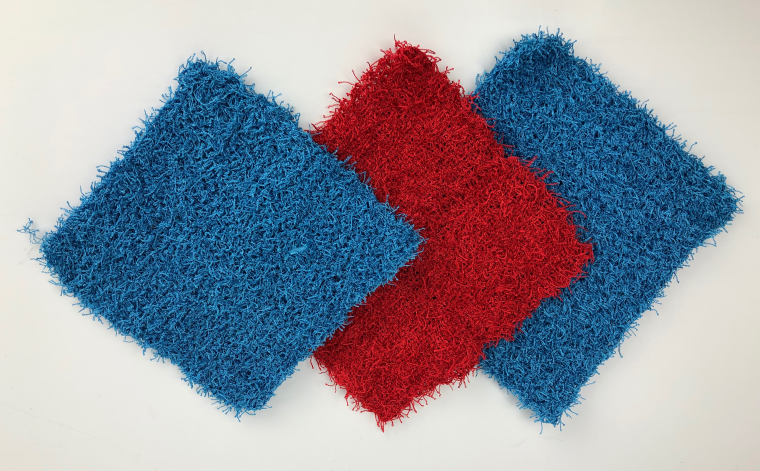
Below is a photo of dishcloths that were crocheted, knit and pin loom woven with eyelash yarn. You can read more about our experience on the blog, Scrubby Dishclothes…and why we say eyelash yarn should be avoided.

crochet, knit, pin loom dishclothes with scrubby yarn

Breaking the Rules

We generally warp/wrap three layers of yarn on the loom and weave one. Most of the time we warp and weave with the same yarn. But mixing and matching is popular too. It changes the entire look of a pin loom woven fabric and can have a drastic effect on your project.

This is where you can experiment; break the rules and use different yarns. You can use a different yarn for each layer or just some of the layers.

Smooth Textured Warp and Textured Weave

A popular combination is wrapping the loom with a smooth yarn then weaving with a textured yarn. This is a great compromise and will save you a lot of frustration and heartache.

Want a scrubby dishcloth? Try warping in cotton and weaving with scrubby.

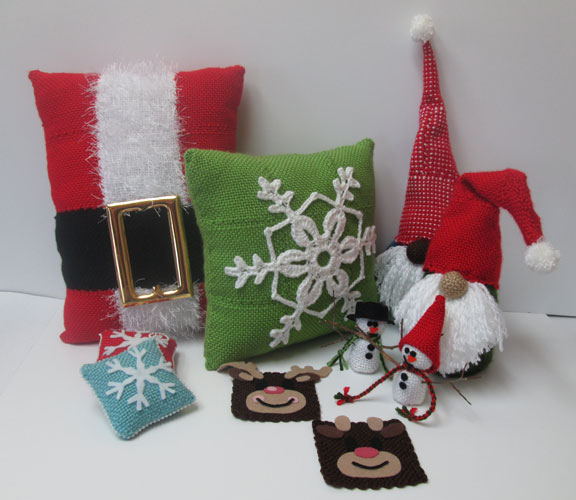
Another fun combination is warping in acrylic and weaving in eyelash. Below is a photo of Santa’s Belly pillow that incorporated eyelash yarn for just the weave portion. Woven Christmas Decorations were made with 4″ pin loom squares and medium worsted weight (4) yarn.

pin loom christmas decorations

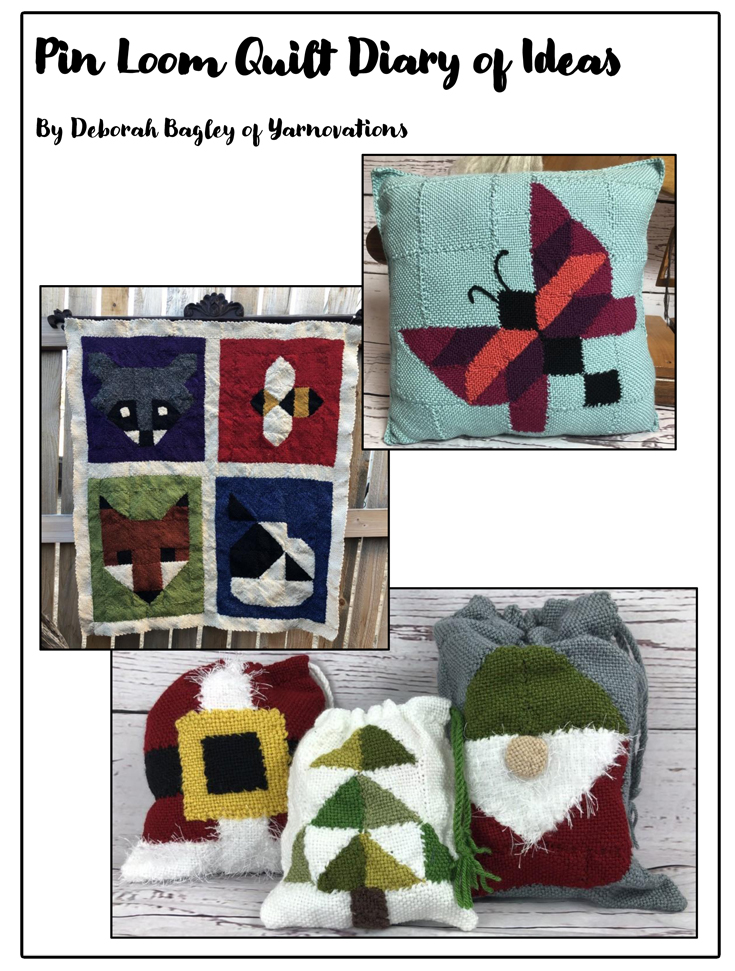
We loved the look of eyelash yarn in woven squares so much, we included it into the beard of the gnome bag found in the Pin Loom Quilt Book of Ideas, too.

A diary of 100 quilt like shapes to make on a pin loom.

Breaking the rules is where you turn on the creative juices. If you have a yarn that you love but think it would be too difficult to use on a pin loom, try using it for only one or two layers. You can also try it for a partial layer to create gorgeous stripes or embroidery.

Yarns to Pin Loom for Beginners

Putting all this information together, we do have a few recommendations for beginner pin loom weavers. It’s not an exhaustive list, just a place to get started. Here are a few yarns we recommend you use as you learn:

  • Cascade 220 Superwash or Cascade 220 Superwash Sport
  • Lion Brand Basic Stitch or Heartland or Baby Soft
  • Red Heart Soft
  • Caron Simply Soft

More could be said, more rules could be made and broken, but we’ll leave it at that.

May you enjoy the journey of experimenting with yarns and creating fabrics and projects that you love.

How to Pack Down Yarn in Pin Loom Weaving

Packing yarn is not about going on a trip and deciding what yarn to take with you. Though I’m sure there are some nuances about what to take and how to pack it. This is about how to straighten yarn strands on the loom between weaving passes.

The Problem

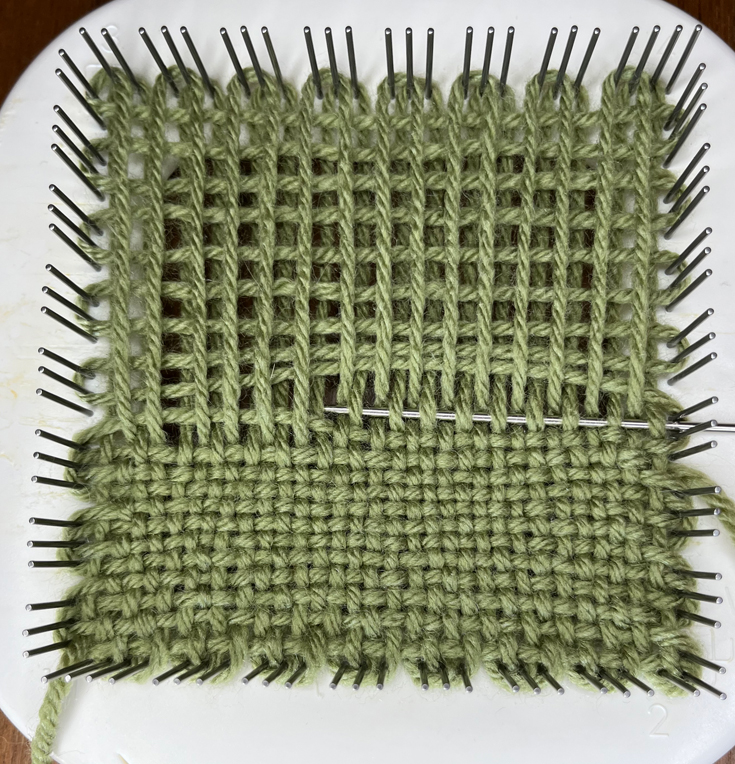
When you weave your yarn through the pin loom, the strands above get pushed out of alignment. It just happens. And that’s a problem because you need to weave above that next strand but there’s not much space to work with.

This problem will continue…from the first weave to the last. Let’s take a look at the problem.

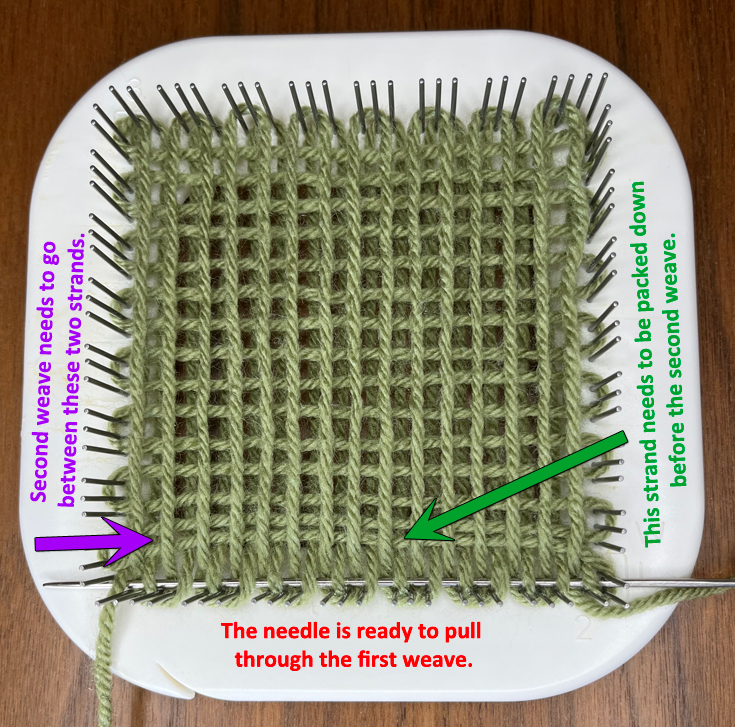
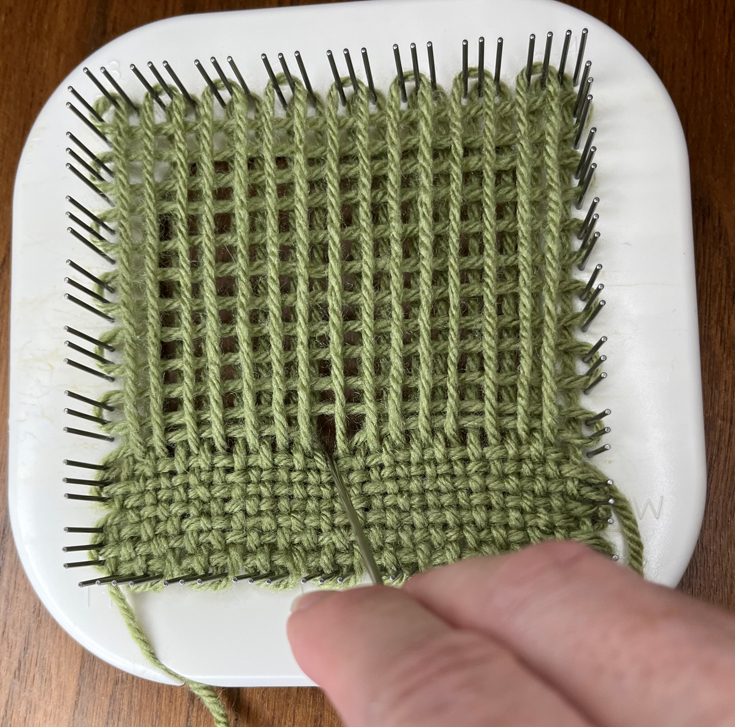
The yarn needle pictured above has been woven through the first row on the pin loom. It is ready to be pulled through. You’ll notice the next horizontal line has risen out of alignment and is very near the third strand. On your next weave, you need to weave your needle between those two strands but there’s not much space.

The Solution

After you draw your needle through your weaving, you’re ready to start packing. Packing means to compress your strands to the bottom of the loom. Packing not only helps align the yarn for your weaving, but it helps create a beautiful fabric by compressing previously woven strands which will make your weaving look more crisp and even.

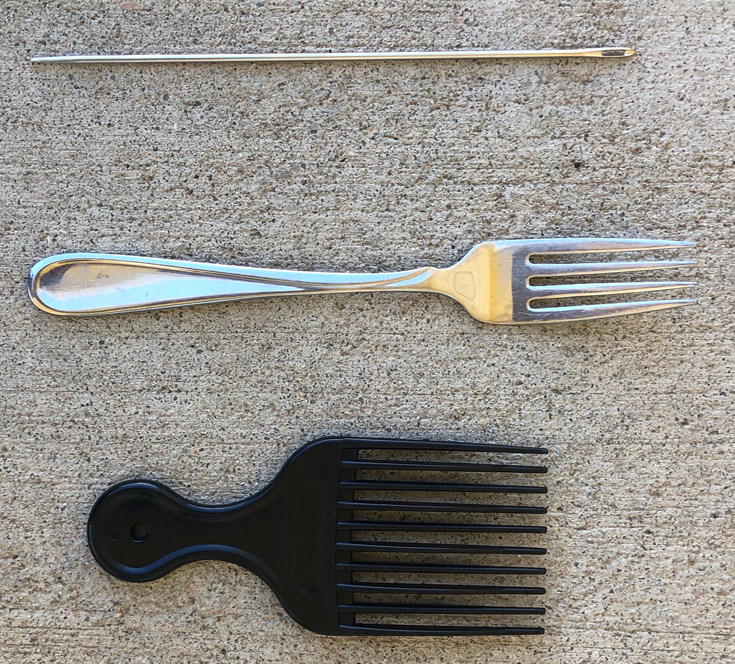
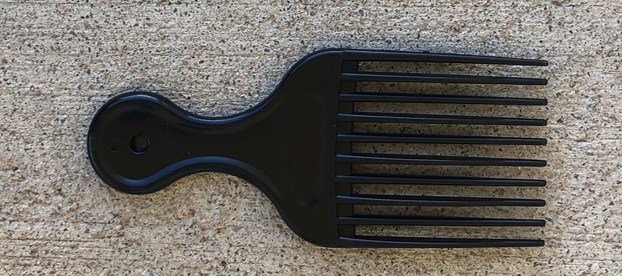
There are a few options for packing. You can use a packing comb, a fork, hair pick or the needle you’ve been weaving with. Experiment with them to see which method or combination of methods you like best. We’ll discuss them in a little more detail below.

packing tools for pin loom weaving

No Packing Comb, No Problem

To straighten weaving strands, you use a packing comb to comb the strand you just wove as well as the next strand to the bottom of the loom. A packing comb is kind of like a metal pet comb. Generally it’s a slender piece of wood with tines. Don’t have a packing comb? Try one of these options:

Pack With A Dinner Fork

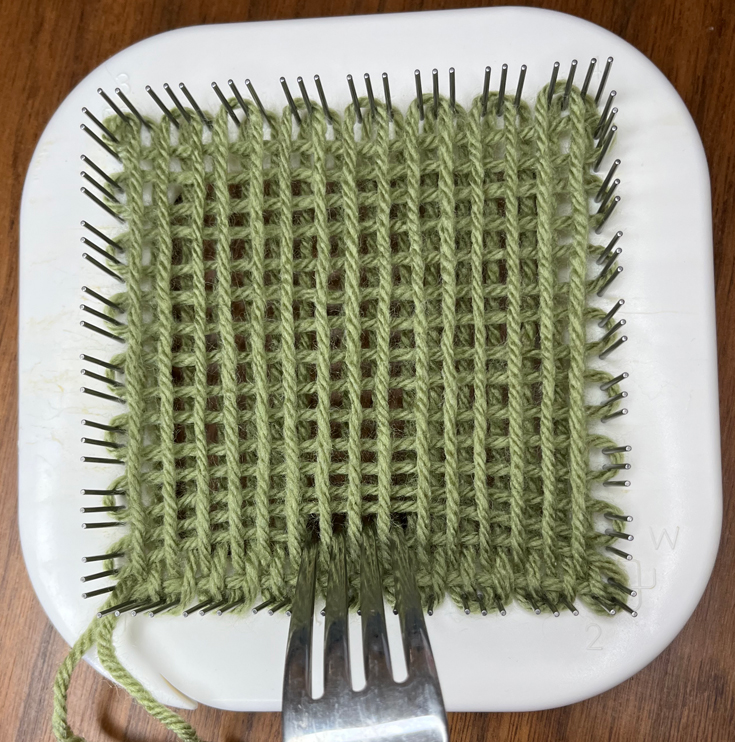
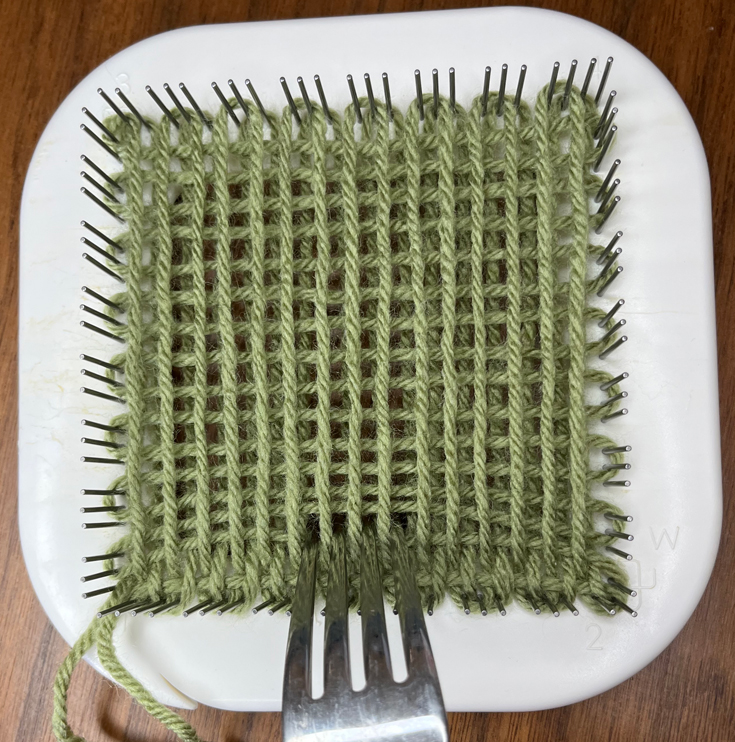
You read that right. The tines on a dinner fork tend to be just the right width for packing weave strands. Place the fork above the strand to be packed and pull it toward the bottom of the loom. You will repeat this process several times moving the fork to the left and right to pack strands across the row.

The down side to using a fork is that it’s narrow. You’ll need to move it many times to pack the strands.

Pack with a Hair Pick

The process is the same as using a fork. Place the pick above the strand to be packed and pull down. The obvious benefit to this over the fork is that it has more teeth and can pack more threads at once. The only down side is that it’s one more tool to keep track of.

Pack With Your Weaving Needle

The packing won’t be as tight, but you can just poke at your work with your weaving needle to pack your threads. This is obviously the slowest method, but the benefit is that you don’t need an additional tool. This method works well when combined with the following packing method “Pack As You Weave”.

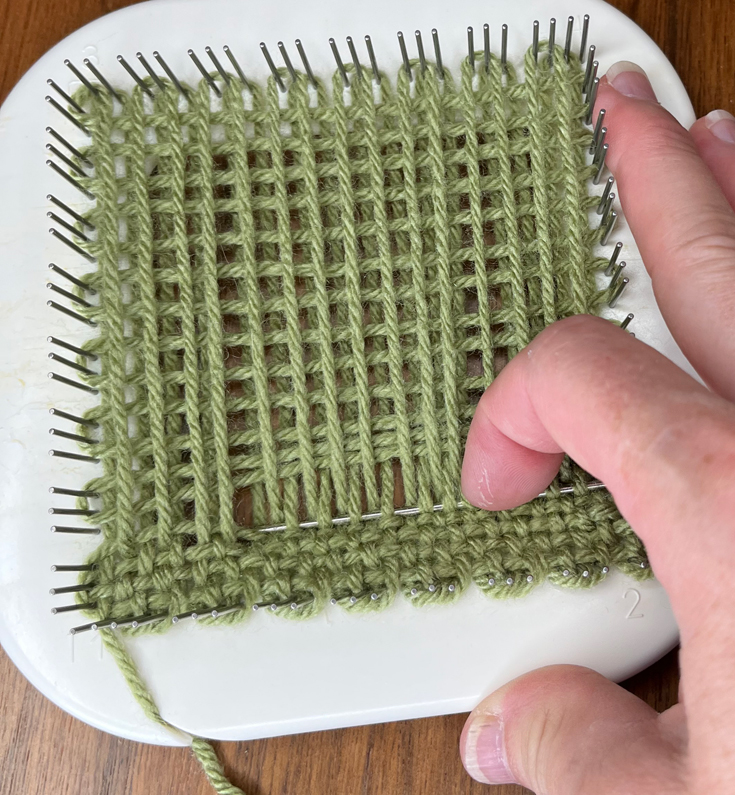
packing yarn strands on pin loom with weaving needle

Pack As You Weave

The yarn needle itself can be a packing tool. Weave most of the row, then press the needle down toward the bottom of the loom to try to smash all the previous woven strands together. I know, not very elegant, but very effective! Packing as you weave will open up your current work area as well as compress your previously woven strands.

This doesn’t solve the problem of the creating space for the next weave, however. So you’ll need to you use this in addition to the method mentioned above “Pack With Your Weaving Needle”, then you won’t need any special packing tools.

We’ve used all of the methods mention above. And they are all great. We have woven so many shapes and misplaced our packing tools often enough that we pretty much just pack as we weave and pack with the weaving needle.

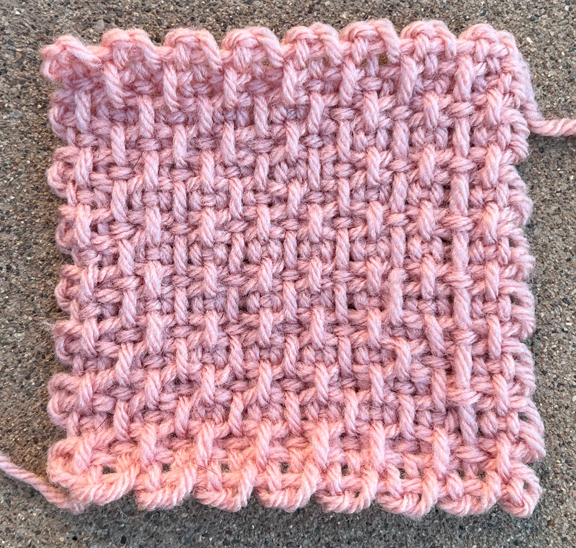
Take a look at the following image of a pin loom woven square. It was packed in our preferred style. It created a nice looking weave even without the use of a special packing tool.

Now that we’ve talked through a few options, it’s time to get packing!

Packing Isn’t So Hard

As mentioned previously, the last few rows can be more challenging to weave. But that’s not always true. If you weave patterns that go over 1, under 3, for instance, packing is easier because the weave is looser. A great example is Loomette Weave #1 which we blogged about.

loomette weave 1 for pin loom

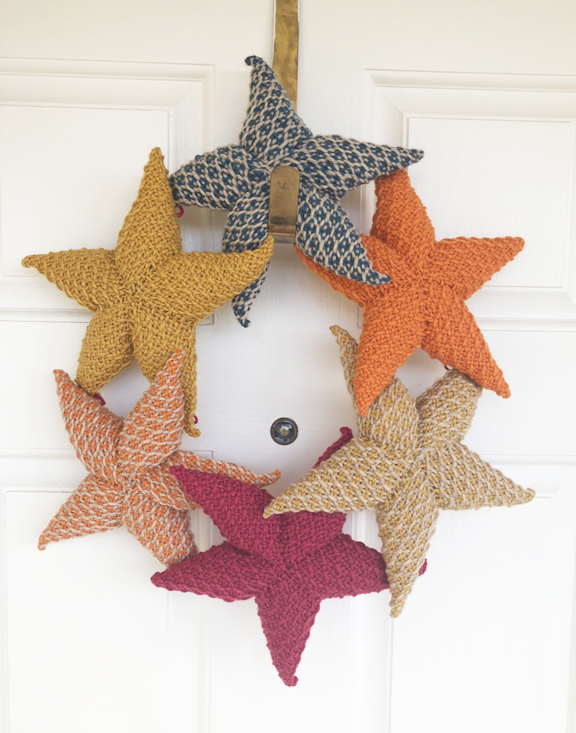
An example of a project where the packing was easier is the Starfish Trio. The cushion star was woven with two different colors of yarn in a weave pattern of over 1, under 3.

11 Tips and Tricks for Pin Loom Weaving

Pin loom weaving is really quite simple. There aren’t a lot “secrets” to the perfect weave, but there are a few things you may find helpful. Here are some of our favorite weaving tip and tricks, in no particular order.

1. Leave A Tail For Weaving

Weaving in tails can be a pain. To keep them to a minimum, consider keeping only one tail, either the starting or ending tail. Use this tail for joining woven shapes. The length of the tail will vary depending on the project you are making. If you are just joining two shapes, then you’ll want a shorter tail – maybe 8″. If you are weaving a large project and joining lots of shapes, you’ll want a longer tail – maybe 12″.

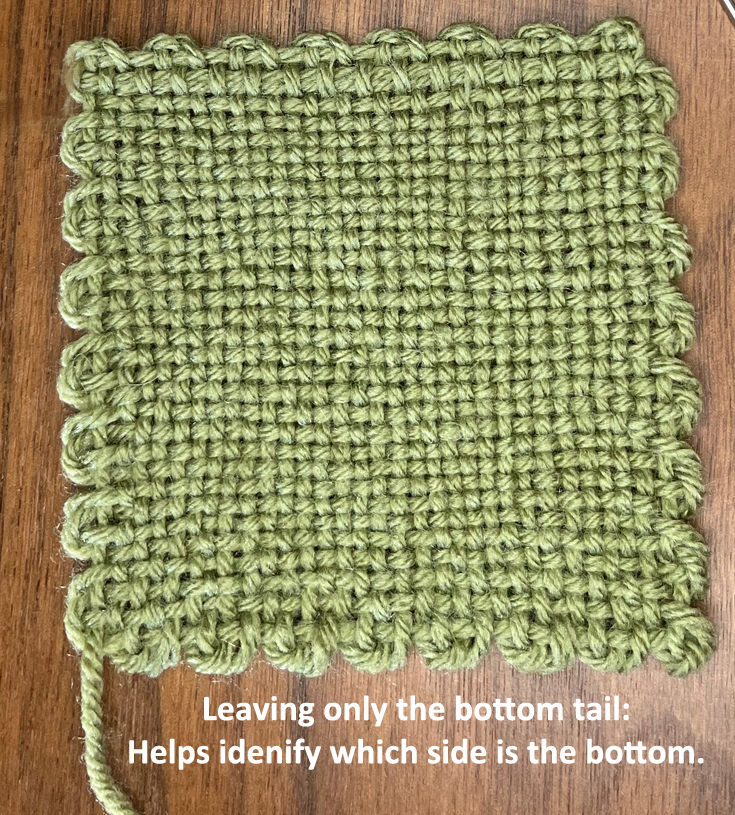
2. Leave A Tail To Identify The Top/Bottom

It can be challenging to identify which side is the top of your shape and which is the bottom. Consistently only leave one tail on your projects to make it easy to identify. If you always weave in your finished tail, then the starting tail helps to identify the bottom of the shape.

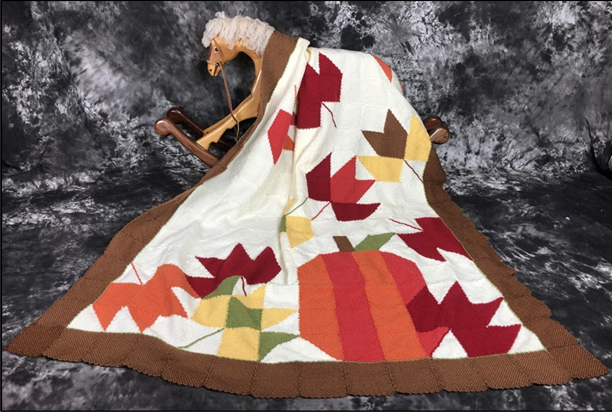
Following the advise of Trick #1 and #2, we were able to lay out the squares in the Falling into Autumn afghan so the bottoms where always down. The top of one square was joined to the bottom of the next. This made joining easier and consistent since the bumps/loops on the outer edge of the pin loom shapes are different on each side. Some woven shapes did need to be turned to make the design, but wherever possible, we tried to lay out and join shapes with the bottom always down.

3. Packing Yarn With or Without a Comb

After the first row (and each row) of weaving you’ll notice that the next couple of strands are out of alignment. The horizonal strands are wavy and uneven making it difficult to find you next weaving path. To straighten the strands, you use a packing comb to comb the strand you just wove and the next strand to the bottom of the loom. Don’t have a packing comb? No problem. You can pack with a dinner fork, hair pick or even your weaving needle. Learn how to pack down yarn and why on our blog: How to Pack Down Yarn in Pin Loom Weaving.

4. Looms Aren’t All The Exact Same Size

Looms can be slightly larger or smaller than their labeled size. Let’s consider the 4″ square loom. Some manufacturers will place the pins so the yarn is woven at 4″ where others will place the pins at 4″, therefore the weaving is slightly larger than 4″. Neither is better, neither is wrong.

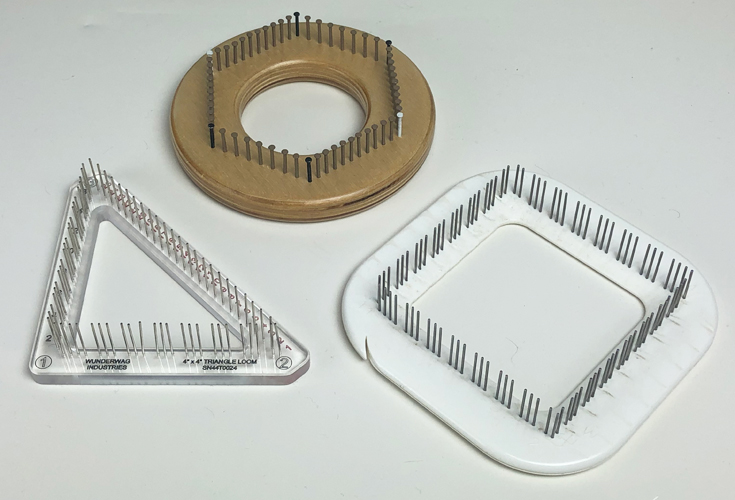
You’ll notice this difference when you join shapes together using looms from different manufacturers. You’ll find that some shapes are slightly larger than others. The Zoom Loom (bottom right) and Wunderwag (bottom left) looms have very similar pin placement and work well together. Bluebonnet Crafters (middle top) looms create shapes that are slightly larger.

For the most part, it’s really not a problem to have a collection of looms from various manufacturers. You may find that there is a little bit of pulling or pooling of fabric as you join them. That’s most noticeable on projects like afghans. We use looms from all three of the manufacturers listed previously as well as looms we’ve made ourselves. We mix and match looms all the time.

5. How To Identify The Strand To Weave Over or Under

Sometimes it can be challenging to find the next strand to weave under or over, especially on the first few rows. When you are weaving “Plain Weave” (under one, over one), you’ll know you found the right strand because it will have a little resistance to it.

In the photo above, the needle is grabbing the yarn that’s lower. It would be easier to weave over it, but in plain weave, that’s the one the needle needs to go under. After that’s picked up, the next strand is the opposite. It’s higher so it would be easier to weave under it. So therefore, it’s the strand that you will weave over.

6. Use Both Hands To Weave

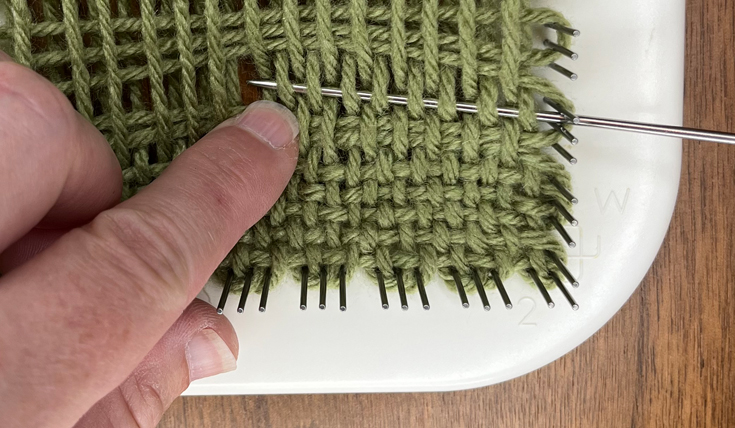
Whether you hold the loom in your hands, in your lap or lay it on a table, you may find it helpful to use both hands to weave. One hand will hold the weaving needle and the other will gently press on your yarn to help move strands to the right or left so it’s easier to weave.

In the photo above you can see that I’m pushing the higher strand to the right which allows me to see the next lower strand that I need to pass the needle under.

Sometimes you may find that it’s helpful to move yarn from on top and other times from below. You may also find that you turn the loom a quarter turn to make weaving easier.

7. Turn The Loom For Comfort

One of the perks of pin loom weaving is that it’s small and portable. That means you can turn it any which way you want to make your weaving experience more enjoyable.

The most obvious would be to turn the loom 180 degrees so you weave in the direction that’s most comfortable. If you’re right handed, then you will most likely weave from right to left. So, turn the loom so that you always start your weave on the right.

Sometimes, however, you may find that you want to turn the loom 45 or 90 degrees. Or maybe you want to tilt it up or down because a strand is being tricky to weave over or under. Or you want to get your hand above or below your work.

Great! You can. We lay the loom on our lap for most of our weaving but often pick it up and twist and turn it as we weave.

8. The Needle Gets Stuck On The Pins

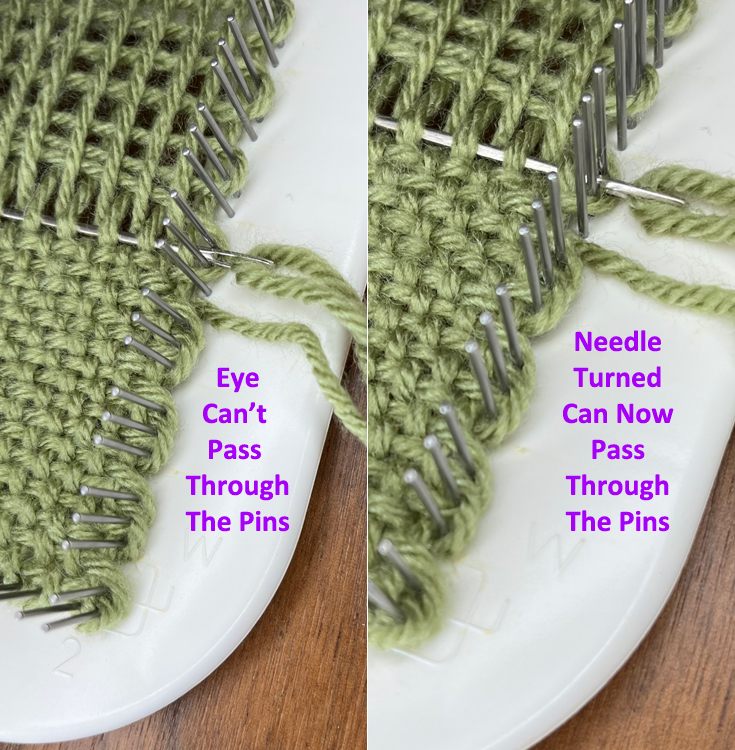
You may find that your weaving needle is too wide to fit through the pins. After you’ve woven under and over strands all the way across, you find that the needle gets stuck. The pins are too close together.

More likely than not, the needle is not too big, but you need to twist it a quarter turn so the eye is not as wide. The eye of the needle has a wide side and a narrow side and you just need to give it a turn.

You can create a bit of muscle memory where you naturally turn the needle at the end of your weaving. Your fingers will feel that the needle needs to be turned just as you start to pull it through. It’s something to practice.

9. Snagged Or Split Yarn

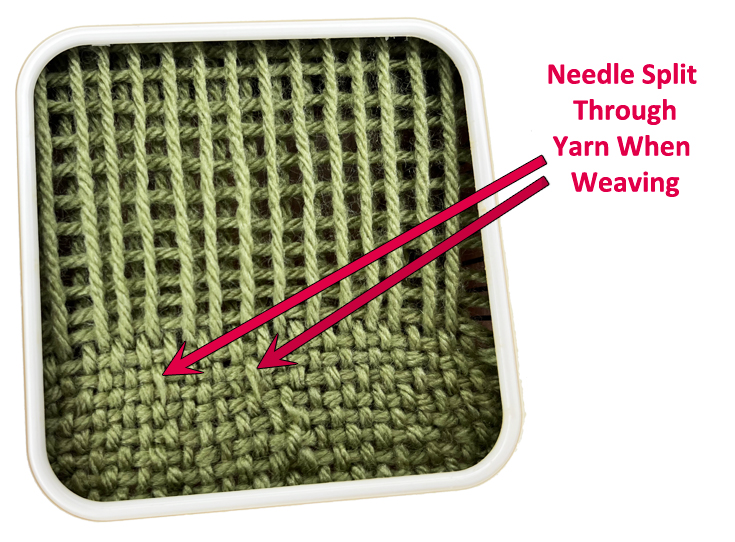
It is really easy to snag or split the yarn as we weave. Meaning the needle went through a strand of yarn instead of completely under or over it. Hopefully you catch that mistake as soon as it happens and you can pull the needle out and reweave the strand. But sometimes you don’t notice.

The problem with snagging and splitting yarn is two fold. First, the yarn is trapped in the middle of a strand and will make packing your weave more difficult and may hinder it from packing tight enough. Second, it will show on the back side and look like you missed weaving a strand; it will look like you wove under 3 and have a long strand.

It’s best to pull out the row and reweave it. If you notice it before you finish weaving your shape, you can try to pull out each row and reweave it. But sometimes we don’t notice until the weaving is complete. In those instances, you can choose to go with it or send the shape to timeout. You may find a use for it in a future project.

10: What Yarn To Use

Because the pins are fixed on a pin loom, the yarn is the only variable you can change. There are a few thing to consider when choosing yarn: yarn weight, fiber content and yarn structure. Below is a VERY brief overview of yarns. Check out the post Selecting Yarns for Pin Loom Weaving for a more details look at yarns and pin loom weaving.

You need 8 yards of yarn to make a 4″ square. We wrote a blog post on What Can You Make With 8 Yards of Yarn and compared pin loom to crochet and knitting.

Yarn Weight

Most people use a light weight (3) or medium worsted weight (4) because the fabric of a pin loom woven shape has some drape yet the holes are small. If you use a thin yarn, you may want to double it up.

Yarn Fiber Content

You can use any yarn but those with some elasticity are easier to weave. When you pull on the strand, does the yarn stretch? Then it has some elasticity. Wool and acrylics are easier to weave on a pin loom than cotton and bamboo yarns.

Yarn Structure

Smooth yarns are the the easiest to work with, and most yarns fit into this category. Yarns with bumps, halos and eyelash yarns are very challenging to weave with.

So, if you’re new to weaving or wanting to work on a relaxing project our recommendations. You only need 8 yards to make a square. Try using one of these:

  • Cascade 220 Superwash or 220 Superwash Sport
  • Lion Brand Heartland or Baby Soft
  • Red Heart Soft
  • Caron Simply Soft

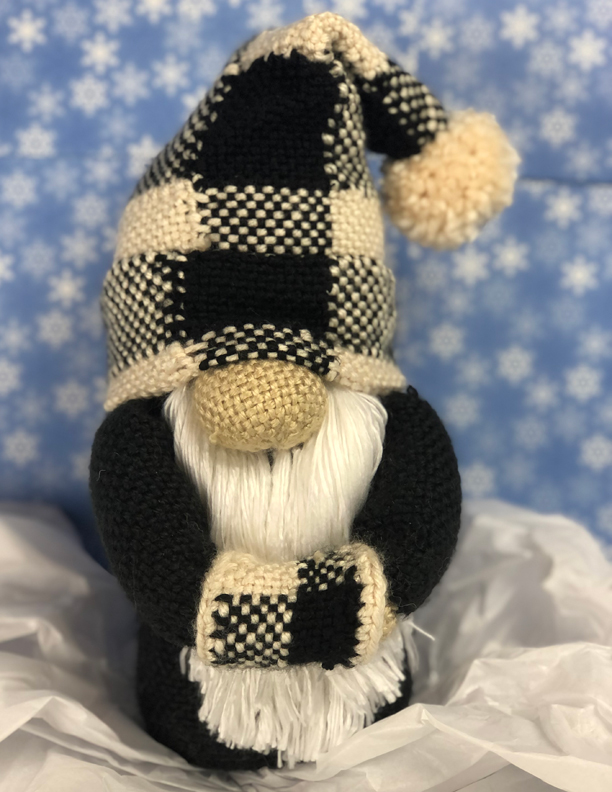
The Gingham Gnome pictured below is an example of a project pin loom woven in Red Heart Soft.

11. Warp The Loom: Loose and Looser

If the yarn has some elasticity (like wool and acrylic), then you want to warp (wrap the loom) loosely. If the yarn has no elasticity (like cotton and bamboo), then you want to warp the loom very loosely. Why? Because as you weave, the warp straights get tighter. By the time you weave the last few rows, the warp strands are very tight.

The photo above is the first warp using acrylic yarn (left) and cotton yarn (right).

For the acrylic yarn, you want to be able to press on the strands and feel it flex. The cotton is warped so loose that it lays on the table and looks really sloppy. We’d say they are both just about right. So definitely pay attention to the fiber content.

Conclusion

Phew, that’s quite a lot of information. As with anything, these are things we learned as we’ve spent time weaving. Your experience may be similar…or not. You may be nodding your head in agreement or may have found something that stopped to make you think.

Wishing you an enjoyable pin loom weaving experience.

Tips and Tricks: Faux Fur

Working with Faux Fur Yarn

There is no doubt that a little faux fur yarn can add a lot of pizazz to a hand crafted project. And with a little practice, one can learn to crochet or knit with it a little easier.

Tip #1: Crocht Double Stranded

It is nearly impossible to see the stitches when crocheting with faux fur. The furry strands nearly completely hide the stitches. That’s great on a finished product, but not so great when you have to work in those stitches. The problem is not as pronounced when knitting since the stitches are on the needle. If stitches have to be picked up, it will be difficult to find them.

Solution: Crochet with two strands at once, one faux fur and one non-furry yarn. It makes each stitch thicker and a little easier to see. If the non-furry strand is the same color (or nearly the same) as the fur, it almost disappears. The thicker stitches may still be difficult to see, but it is also possible to feel the stitches as you work.

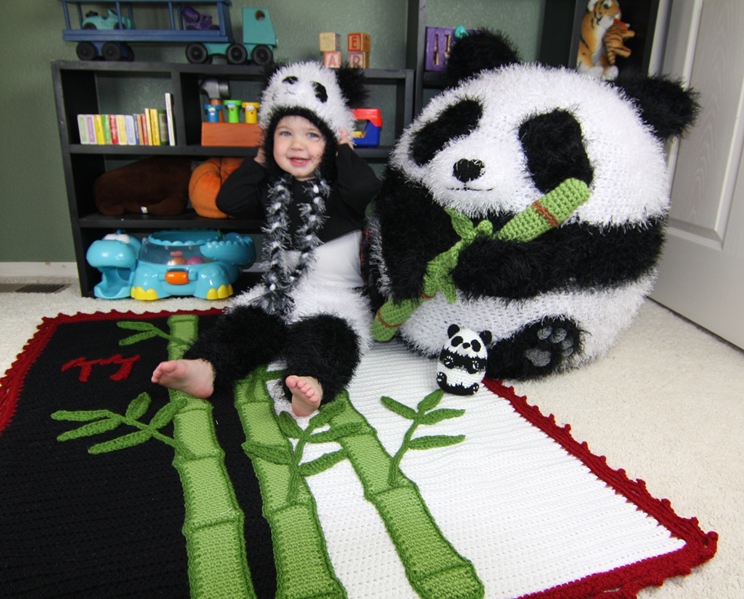
A Furry Sitting

Crocheting with Vanna’s Choice and Fun Fur yarn made finding the stitches in this panda set much easier to find.

Panda Pattern Set available on Etsy.

Tip #2: Count every row.

Counting the number of stitches at the end of every row or round is generally a good idea, but it is almost critical when using faux fur. It is very easy to drop a stitch or lose  track of a stitch because it can be difficult to see. You might even add a stitch because it’s not always easy to tell if a stitch has been worked in already.

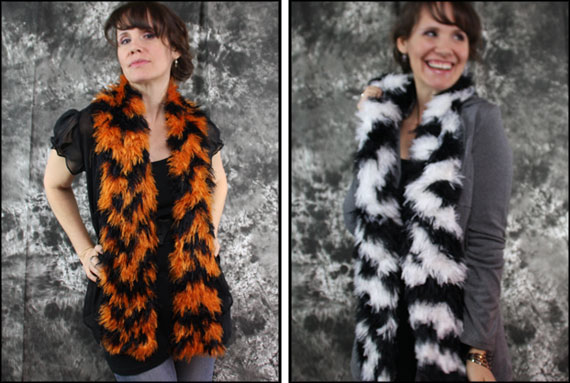
Tiger Striped Scarves Crochet Pattern

Keeping track of the number of stitches per row is crucial to keeping a neat edge in projects like the tiger striped scarves.

Tiger Striped Scarves pattern on Etsy.

Tip #3: There is a Right Side and a Wrong Side.

The little furry strands often get trapped within the stitches as they are worked. When working back and forth in rows, both sides will generally be equally furry. When working in the round, the inside tends to be furrier. For a furrier look, turn the project inside out when appropriate so that the furrier side is out.

A hat can often be turned inside out after it’s finished. Some items may need to be turned inside out before they are sewn together. Just note how furry the sides are before completing the project.

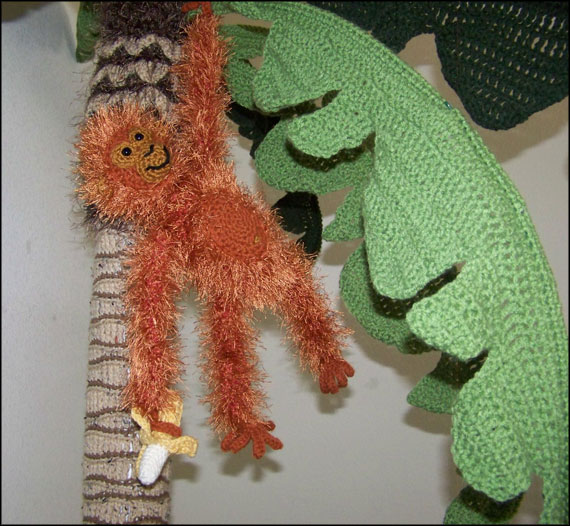
Monkey Hanging in Palm Tree with Banana

The parts of the monkey are turned inside out to keep the furrier side on the outside. A little faux fur on the tree makes the palm tree look more authentic too.

Palm Tree and Monkey pattern set available on etsy.

Tip #4: Not all faux fur is equal.

Faux fur comes in varying lengths. The furry strands can be short or long, coarse or smooth. The type of fur can significantly impact the look and feel of the finished product. Projects with the longer strands of fur tend to look fuller and are softer than the shorter stranded fur. The size and nature of the project may determine which fur to use. Generally speaking, the longer stranded fur costs a little more.

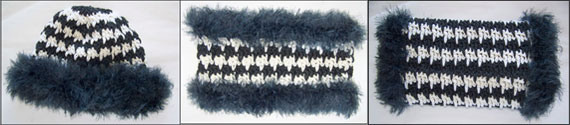
Houndstooth Trio

 La Furla from Trendsetter Yarns is long and soft making this houdstooth trio very luxurious.

Houndstooth Trio pattern set available on Etsy.

Tip #5: Notice yardage.

Some faux furs come in small skeins. Generally speaking that means more skeins of fur yarn will be needed than non-furry yarn. Projects with smaller stitches will use more faux fur than larger stitches. For instance, a project  crocheted using single crochet will use more than the same project done in double crochet. Because the faux fur hides stitches anyway, you might want to change the stitch to a taller stitch to save on yarn. The project will get done faster and still look good.

Halloween Trick or Treat Bags

One skein of faux fur will work for small projects like the trick or treat bags.

Trick or Treat Bags pattern set available on Etsy.

Tips and Tricks: Color

Color Tips

One of the simplest and easiest ways to adjust a knit or crochet pattern is to change the color. There are several things to keep in mind before changing the color.

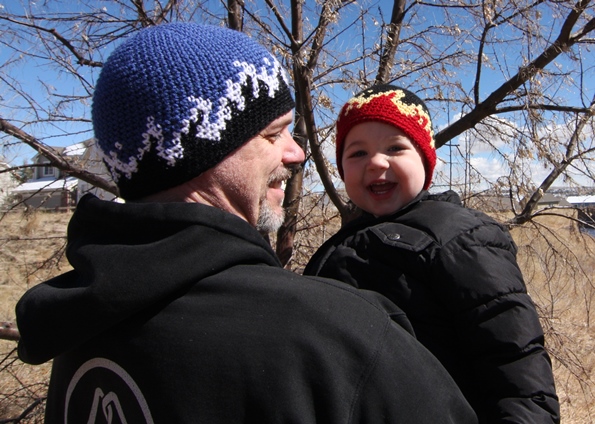
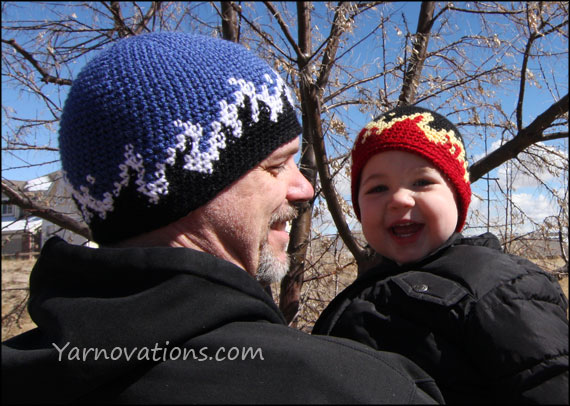
Flame Beanies

Flame Beanies

Substitute Yarn. Use the colors suggested by the designer. If the exact yarn is not available, be sure to substitute with the same weight yarn. If the pattern calls for a light weight yarn (3), try to find another light weight yarn. Substituting with a medium could significantly change the size of the finished project. In the case of beanies pictured above, if the yarn used is larger / heavier than suggested, the hats may end up too big. If gauge is not important, feel free to substitute with any weight and adjust the crochet hook accordingly.

Flame Beanies pattern on Etsy.

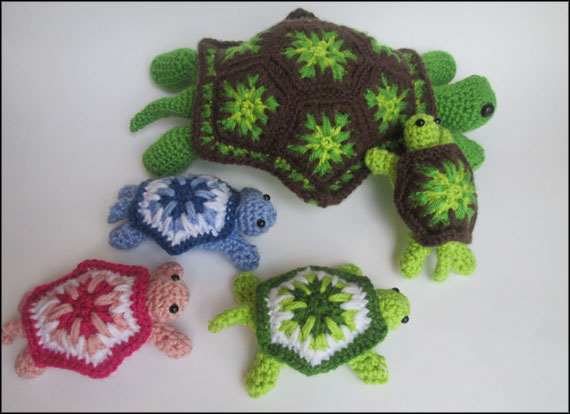
Turtle Family

Turtle Family

Fit a Theme. You might want to change colors to fit a theme. Sometimes you want to change the color to a person’s favorite color or you want to match the colors of a person’s room, like a nursery. Notice where the darker colors are used. If you like the original pattern, try to keep the darker colors where the darker colors are used. Keep in mind, some patterns will look fabulous in a different order as well. The turtles pictured above show the same pattern with various color schemes. I went for traditional, then attempted to make one similar to the blue and white porcelain of the 14th century.

Turtle Rattles and Blanket pattern on Etsy.

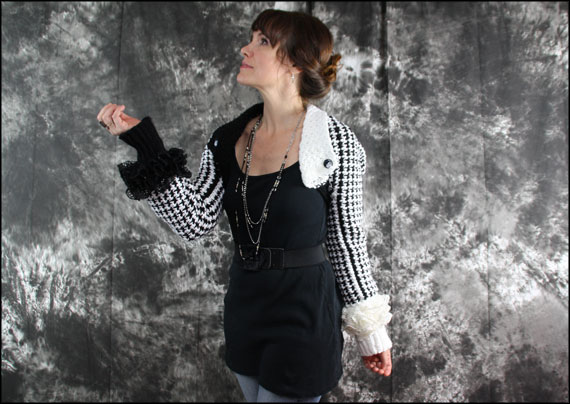
Houndstooth Shrug

Houndstooth Shrug

Notice Stitch Patterns. Some patterns don’t look good in all color schemes. Sometimes a solid color will look better than a variegated color and vice versa. Sometimes the designer chose odd colors but the pattern is beautiful. Look at the stitch work itself and decide if it’s something you like. Houndstooth is often done in black and white, but it would look equally stunning in various colors. I did see a project in lavender and grey. Because the colors were so close, the houndstooth pattern was almost invisible. The stitch work is great, but more contrasting colors would be better.

Houndstooth Shrug pattern on Etsy.

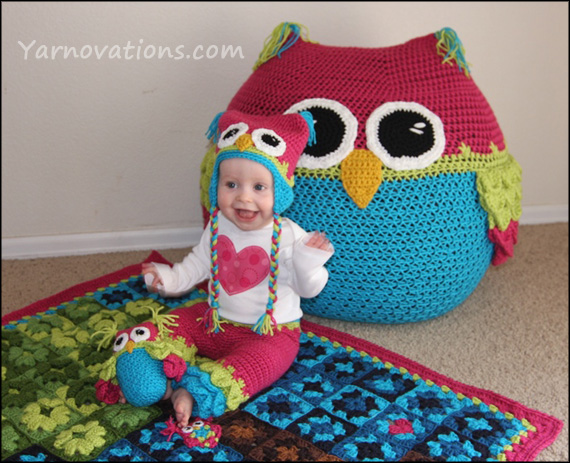
Owl Bean Bag Set

Owl Bean Bag Set

Go Whimsical. Realism has its place, but sometimes fun and fanciful color schemes can work just as well.

Owl Bean Bag pattern on Etsy.

Owl Complete Set pattern on Etsy.

Granny’s Tree of Love Blanket photo tutorial on Etsy.

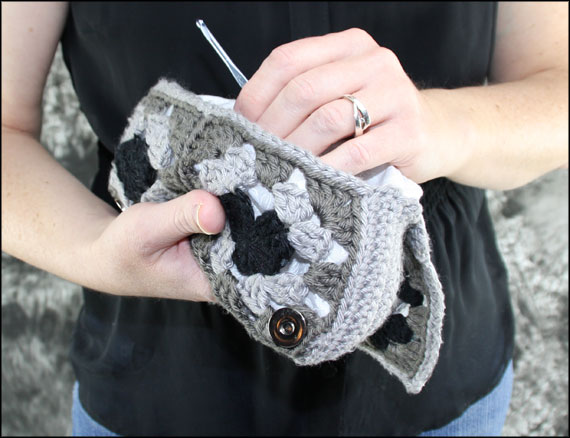
Perfect purse for crochet hooksGo Tonal. Working in tones can make for striking projects. Work from light to dark or dark to light, or vary the tones for more stunning transitions.

Heart Centered Granny Clutch pattern on Etsy.

Hiking Buddy

Hiking Buddy

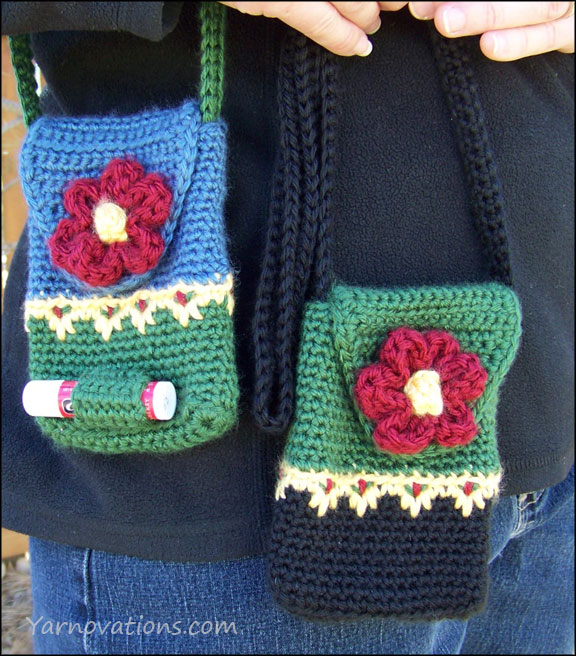
Notice the sheen of the yarn. Some yarn has a matte look while others are shiny. This can impact the appearance of the final project as well. Would a doll look better shiny or dull? Perhaps the doll would look better in matte colors while the dress is shiny. This hiking buddy pictured above was done in shiny Caron Simply Soft.

Hiking Buddy purse pattern on Etsy.

Frog it! Sometimes one color doesn’t look as good as we’d like. It might be worth ripping out and trying another color.

Crochet Abbreviations

Crochet Abbreviations

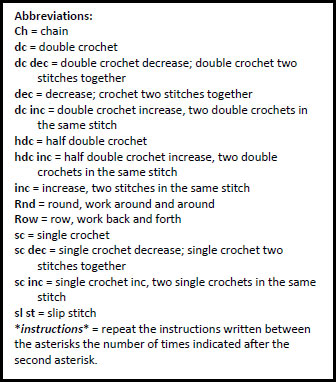
Sample Abbreviations ChartReading a pattern full of abbreviations can feel a bit overwhelming. It can also be very entertaining. Some girlfriends asked me to teach them how to crochet and I started by having them look through a magazine to show them how diverse the craft is. They started to phonetically read the patterns and we all laughed at how strange it sounded.

It’s easier than you might think to read a pattern. Patterns try to abbreviate wherever possible to keep the instructions short and compact so that the instructions aren’t a bazillion pages long (yes, I exaggerate a bit). If you know the basic stitches (chain, slip stitch, single, half double, double crochet), then reading a pattern will be easier.

Abbreviating Crochet Terminology

Crochet language is abbreviated a couple different ways.

  • The first letter of each word is used. 
    For example: “sc” is the first two letters of “single crochet”
  • The first few letters of a single word are used.
    For example: “beg” is the first three letters of the word “beginning”
    For example: “inc” is the first three letters for the word “increase”
  • There are some instances of compound abbreviations…but again, they use the principles mentioned above.
    For example: “sc2tog” means single crochet 2 stitches together.

Though abbreviations have been standardized, no two designers write the same. It’s up to each designer to choose how much instruction to give and how much to condense. I’ve seen patterns that are nothing more than numbers that look like ratios (i.e. 1:7, 2:14, 3:21). My sister and I tend to write more, not less. We write step-by-step instructions so that you can duplicate our process, using common abbreviations so that our patterns are too lengthy.

Many patterns will also have an abbreviations list. Refer back to that when you get stuck with an abbreviations. Deborah and I include an abbreviations list in all our patterns.

For a list of commonly used abbreviatons, visit our Crochet Abbreviations page.

US vs. UK Terminology

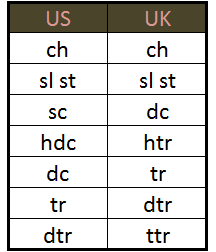
Just when you think you have the language of crochet all figured out…you run into one big snag: US and UK Terminology is not the same! They may sounds the same…but they’re not.

A single crochet in US is called a double crochet in the UK.

Here is a conversion chart for US vs. UK Terminology:

US UK Abbreviations Chart

Deborah and I write all our patterns in US terminology.

Problems Reading a Pattern

If you are having problems reading a pattern, you have a few options:

  1. Ask for help from a knowledgeable crocheter.
    This could be a friend, relative or someone from a yarn shop or crochet group.
  2. Find a different pattern for the same thing.
    It could be that the writing style of the designer doesn’t work for you. See if someone else has a pattern that is easier to understand.
  3. Educate yourself on YouTube.
    You may need help with a specific stitch like the crocodile stitch. Watching videos to learn crochet stitches will make it easier to read your specific pattern.
  4. Ask the designer.
    If you are struggling with a particular spot in a pattern, you may want to touch base with the designer. There could be a problem with the pattern or with the way the instructions were written.

The best way to learn is by doing. Find a pattern for something you want to crochet and give it a try. If you need patterns, we recommend browsing through Ravelry.com.

Fair Isle vs. Intarsia

Fair Isle vs. Instarsia

Many knitting patterns involve color changes while most crochet patterns do not. Why is that? Having changed colors in knitted and crocheted projects I will say that it’s not because it’s easier to do when knitting. I actually found it easier to change colors while crocheting. There are two ways to change colors when knitting or crocheting, Fair Isle and intarsia. I have used both methods and the method I use depends on the project being made.

Fair Isle

Fair Isle, also called “stranded colorwork”, has several characteristics.

  1. It’s usually done in the round, like hats and sweaters.

    Flame Hats and Mittens

    Flame Hats and Mittens

  2. It traditionally uses only two colors per round. Other rounds may use two different colors, but each round uses two.
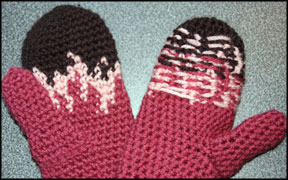
  3. The yarn is not cut but is crocheted over or dropped (to the back/wrong side)and picked up when needed. This leaves a strand of yarn on the back. For mittens, it is easy to snag the strands on the inside with a finger when putting the mittens on.
  4. The Flame Hat and Mittens are great for learning Fair Isle as the color work is only along the brim of the hat or the fingers of the mittens.

Mittens

Pictured left is a pair of mittens from our Flame Beanies and Mittens Set. The mitten on the right shows the wrong / inside of the mitten. Strands of yarn are carried along the inside until it is needed again.

As mentioned above, these are crocheted in the round. The beanies have a similar stranded look inside.

Flame Beanie and Mittens pattern available on Etsy.

Intarsia

Intarsia has several of its own characteristics.

  1. It’s usually done in rows on flat pieces.

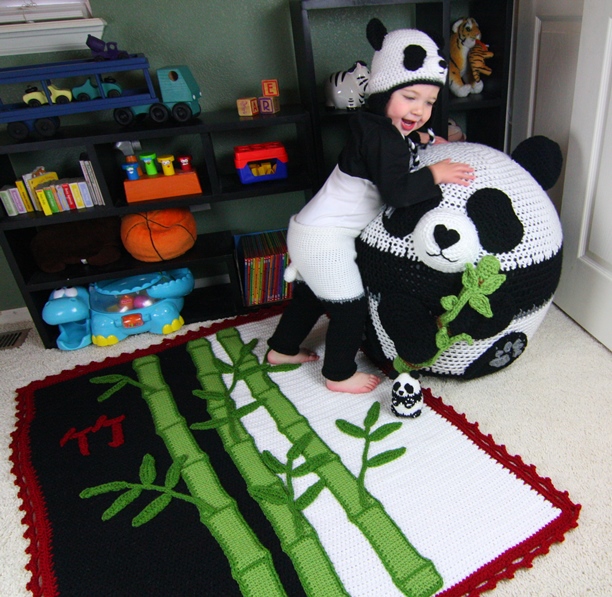
    Panda Set

    Panda Set

  2. A ball or bobbin of yarn is used for each color section and is dropped and left dangling until is it picked up and used on the way back.
  3. The yarn is always dropped to the project’s wrong side. Because it is worked in rows, sometimes it is dropped to the back and sometimes it’s dropped to the front.
  4. The Bamboo Blanket has only two color sections, black and white, making it a great beginner piece for Intarsia work. That means there are only two skeins or balls to keep track of when crocheting. The bamboo stalks are crocheted separately and sewn on.

Panda Set pattern available on Etsy.

Both Fair Isle and Intarsia use charts/graphs instead of written out instructions. Generally one box in the graph equals one stitch. Graphed work looks best in single crochet though half double crochet can work, depending  on the graph. Keep in mind, stitches in crochet do not line up one on top of another like knitting does. When trying to make vertical lines and things like letters, they will end up looking a little wavy. The stitches will line up a little more when working in rows. A vertical line will tend to lean right when working in the round.

There are just a few other tips for creating a successful piece of color work.

  1. When changing colors, you should use the new color for the last YO that is pulled through the loops on the hook.
  2. Tension can be a problem. If part of the project changes colors and part of it does not, sometimes one section is tighter than another. Be aware that you may need to relax during the color changing section.
  3. It is also easy to make a tighter section if there are long sections where a color isn’t used in Fair Isle. Crocheting over the unused yarn every 2-3 stitches helps keep the tension relaxed. Imagine trying to put on a hat that has no give because the strands are too tight.

My first projects were hats and scarves. They were small enough to practice on and I could pull them out and try again if something wasn’t quite right. With a little practice, it is possible to get into a rhythm with dropping and picking up the different colors. There is no reason Intarsia and Fair Isle can’t be just as popular in crochet as it is in knitting.

For a fun Fair Isle project, try the Flame Hats and Mittens.

Flame Hats and Mittens available on Etsy.

For a fun Intarsia project, try the Bamboo Blanket.

Panda Set available on Etsy.

Craftsy References and eGuides

Craftsy References and eGuides

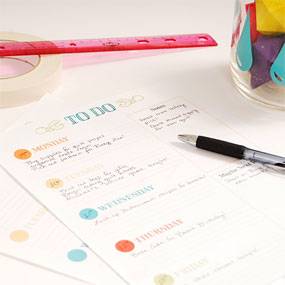
To-Do-ListWe don’t blog about it much, but we are fans of Craftsy. It’s a wonderful place for online classes. The videos are high quality, the teachers are knowledgeable and there are lots of subjects to choose from. I (Dana) recently learned that they have a bunch of free references and eGuides. Oh, yeah…sign me up!


The References are like mini classes packed with nuggets of wisdom. They can be downloaded to your computer or viewed on a browser. Here are a few of their eGuides:

Photography
eGuide: Understanding Exposure for Better Photos Now: Beginner Photography Tutorials
Cake Decorating
eGuide: Not-So-Basic Buttercream Decorating Ideas
Food & Cooking
eGuide: Delicious Doughnut Recipes You Can Make at Home
Paper Crafts
eGuide: 6+ Stash-Busting Paper Craft Projects
Drawing
eGuide: Drawing the Human Face: A Primer
Painting
eGuide: Beginner’s Guide to the World of Watercolor
Gardening
eGuide: Success With Container Gardening
Woodworking
eGuide: Woodturning Basics for Beginners

Being a former paper crafter, the eGuide for 6+ Stash Busting Projects is one of my favorites. And as someone who needs to take better pictures, the photography  eGuide is one I’m going to be memorizing. Of course, they have eGuides for crochet and knitting, too. I really like their Metrics Conversion Guide! I’m definitely going to print that out and put it by my work station (ok, it’s going on the coffee table in front of my couch).

Fun References on Craftsy

There are other fun (and free) references on Craftsy, too. As someone who likes to plan, the To Do List and Project Planner definitely resonate with me.

The easiest way to access the Craftsy References is to visit their blog and click on references in the left sidebar.

Enjoy!